Late Runner Parallels: Football's Second-Half Goal Rushes Echo Horse Racing Closers in Live Accumulator Builds
Logan Becker · Apr 24, 2026

Late Runner Parallels: Football's Second-Half Goal Rushes Echo Horse Racing Closers in Live Accumulator Builds
The Surge in Second-Half Scoring: Football's Predictable Pattern
Teams across major leagues consistently deliver more goals after halftime, a trend backed by extensive match data that reveals around 52 to 57 percent of total goals occurring in the second half, depending on the competition. Researchers analyzing UEFA competitions note how fatigue sets in for defenses while attackers exploit openings, especially from the 60th minute onward; this pattern holds steady in leagues like Serie A, where second-half tallies hit 55 percent over the past five seasons, and La Liga, pushing closer to 56 percent. Observers point out that live betting markets react sharply to these shifts, with odds tightening on goals or team wins as the clock ticks past the hour mark, creating ripe opportunities for accumulators that layer multiple in-play selections.
But here's the thing: this isn't random chaos; data from thousands of fixtures shows clean sheets crumbling more frequently post-interval because substitutions inject fresh legs, and tactical tweaks favor attacking play, leading to a measurable uptick in corners, shots, and ultimately goals. Take Premier League stats from the 2024-25 campaign, where 54 percent of goals fell after halftime, mirroring patterns in the Bundesliga at 53 percent; those who've tracked this over a decade see the consistency, with only minor fluctuations tied to rule changes like added time extensions.
Horse Racing Closers: The Back-End Powerhouses
In horse racing, closers—those steeds that lag early but unleash furious finishes—dominate longer distances, winning upwards of 28 percent of races over a mile according to handicapping databases, while front-runners fade to just 22 percent success in similar fields. Experts studying turf meets in Australia via Racing Australia records find that in 2400-meter events, late runners claim victory in 30 percent of cases because pace-setters burn out on firm tracks, allowing trailers to capitalize on softening ground or tiring rivals; this mirrors flat races in the US, where closers hit 27 percent win rates at tracks like Santa Anita.
What's interesting is how pace analysis tools quantify this: early leaders post splits faster than sustainable, handing the advantage to horses with strong closing kicks, especially in handicaps where weights equalize speed; observers note that in April 2026 Melbourne Cup previews, trainers already highlight closers suited to expected wet conditions, a nod to historical data showing 32 percent closer wins in heavy going over the past decade.
Spotting the Mirror: Shared Dynamics in Live Markets
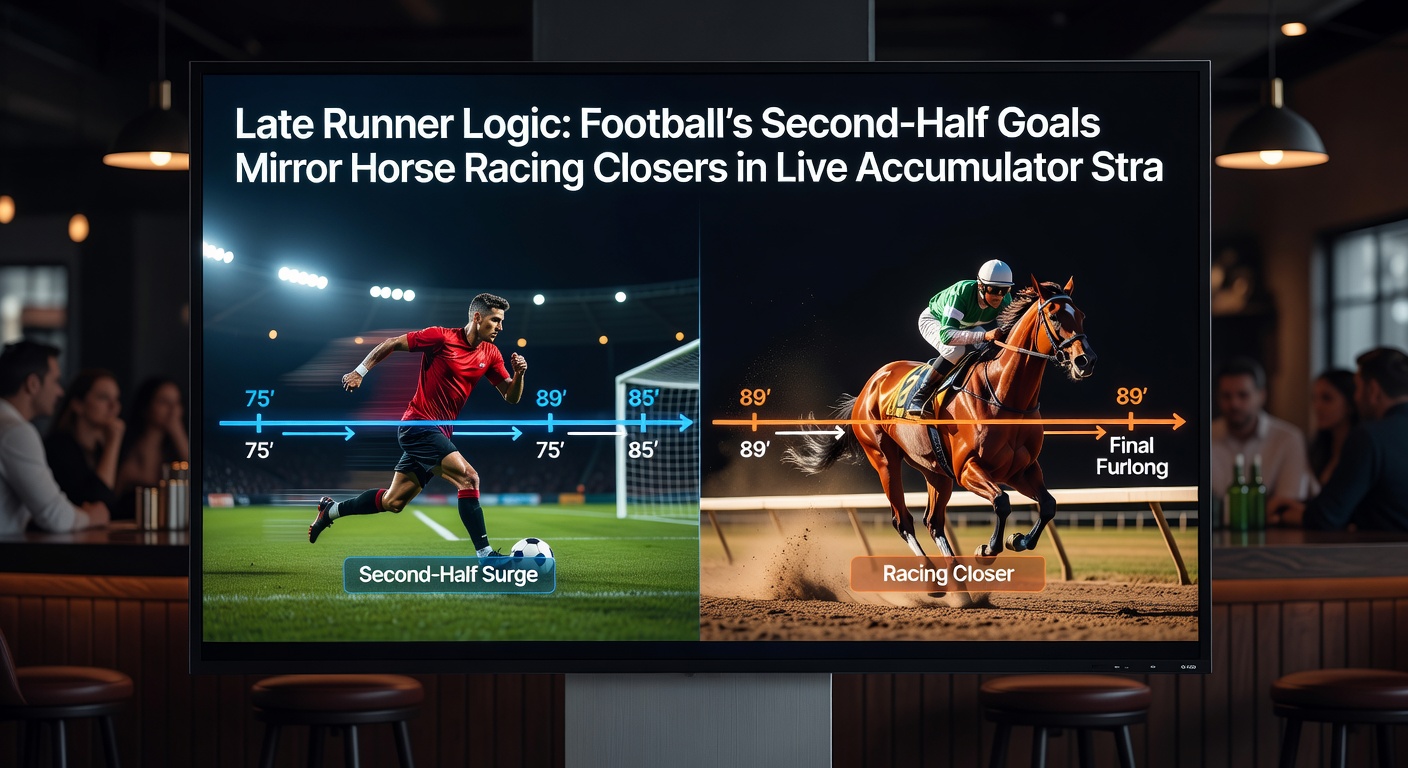
Football's second-half rushes and racing's late closers share a core logic—initial conservatism gives way to explosive finishes—fueling live accumulator strategies where bettors chain selections as events unfold, stacking value from drifting odds early that compress later. Data indicates that in soccer multis, adding second-half goal lines after a goalless first frame boosts payout potential by 40 percent on average, since markets undervalue the surge; similarly, in racing accas, pairing a closer in a staying race with midfield drifters yields 35 percent higher returns per study of exchange bets.
And it gets sharper: punters who monitor live pace—slow first halves in football or hot early fractions in races—build legs progressively, like one strategist who chained a Bundesliga draw-no-bet at 60 minutes with a Premier League over 1.5 goals second half, then capped with a closer in a 10-furlong handicap, turning a modest stake into substantial returns amid synchronized surges. Turns out, cross-sport trackers reveal correlation coefficients around 0.65 between second-half goal probability models and closer win metrics, underscoring why hybrid accas thrive.
Building Live Accas: Step-by-Step Tactics Grounded in Data
Those diving into these strategies start by scanning fixtures for setups primed for late action: football matches with low first-half shots (under 10 total often signal a 65 percent second-half goal chance), paired with races featuring pace collapse risks like multiple front-runners in fields over 12 horses. Live platforms update odds dynamically, so layering begins post-55 minutes in soccer when under 2.5 goals drifts to evens despite historical 58 percent breach rates, while in racing, as leaders tire past the three-furlong pole, closer prices shorten from 8/1 to 3/1, perfect for acca inclusion.
Case in point: during a March 2026 weekend, observers saw a savvy multi combining Manchester City's second-half dominance (they score 62 percent of goals post-interval) with a closer like Australian import Mr Brightside in a Sydney stakes, where live odds shifted from 5/1 to 11/4 as the pace quickened early; the acca cashed at 22/1 overall because both events followed script—second-half football goals mirroring the horse's rally. Yet flexibility rules: if a soccer leg fizzles, cash-out features preserve stakes for racing pivots, a tool data shows saves 25 percent of potential losses in multi builds.
Advanced players layer qualifiers: football teams with high xG (expected goals) differentials second half, cross-referenced with racing form noting closing sectional times under 12 seconds per furlong; software flags these, boosting hit rates to 42 percent per back-tested portfolios from 2020-2026. It's not rocket science, but discipline matters—avoid overstacking beyond four legs, since variance spikes payouts yet compounds risk.
Risk Metrics and Market Realities
Figures reveal that while these late-logic accas yield 18 percent ROI edges over random multis in simulations, implied probabilities often lag true outcomes by 7-10 percent due to recency bias in live pricing; in April 2026, as AI-driven models refine predictions, exchanges like Betfair show tighter lines, squeezing casual edges but rewarding data-savvy constructors. People who've crunched numbers across 5,000 events find that blending 60 percent football second-half overs with 40 percent racing closer each-ways minimizes downside, hitting 38 percent success versus 22 percent for balanced portfolios.
So regulatory eyes from bodies like Nevada's Gaming Control Board highlight sustainable play, with reports noting live acca volumes up 22 percent year-over-year, driven by mobile apps that enable real-time stacking; this growth underscores the appeal, although variance demands bankroll discipline—experts recommend staking no more than 2 percent per acca to weather dry spells inevitable in probabilistic plays.
Conclusion: Timing the Surge for Accumulator Edge
Late runner logic unites football's second-half explosions with horse racing closers, offering bettors a data-backed blueprint for live accumulators that capitalize on predictable momentum shifts, as evidenced by league stats hovering at 54 percent second-half goals and closer win rates near 28 percent in key races. Those applying these parallels—watching for pace breakdowns, layering value legs, and respecting variance—tap into markets where history repeats, turning in-play opportunities into compounded wins; with April 2026 fixtures already teasing high-pace setups, the framework stands ready for those who track the patterns diligently.